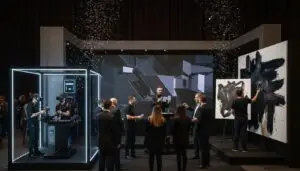
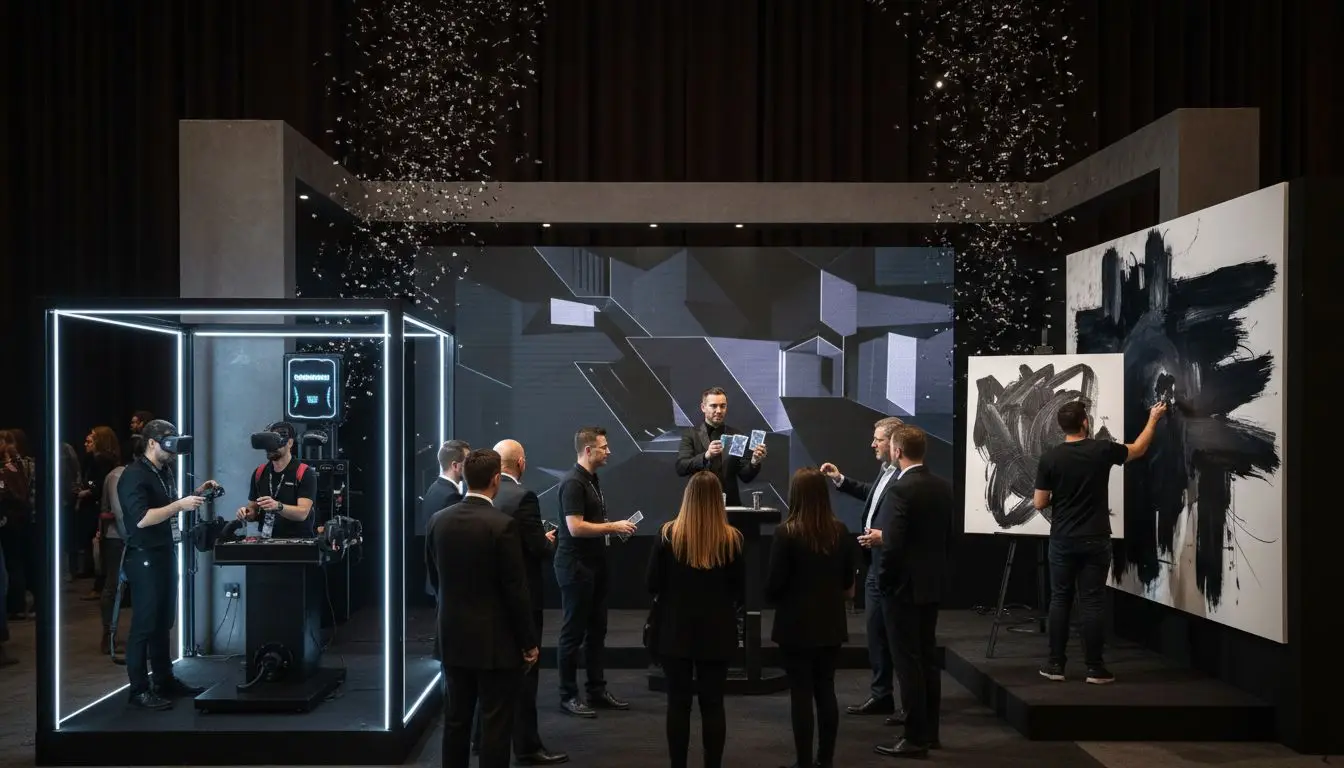
Trade show floors are crowded, noisy, and full of competing messages. The right trade show entertainment turns that chaos into opportunity: it draws attendees, creates memorable brand moments, and gives your sales team warm conversations instead of awkward cold calls. This guide walks you step-by-step through choosing entertainment, setting a realistic budget, executing logistics, and measuring results so your next show delivers clear business value.
Why Trade Show Entertainment Matters (and what success looks like)

Trade shows are still one of the most efficient channels for building B2B and B2C relationships in-person. Entertainment is not a gimmick when it's aligned with goals: it's a traffic builder that increases dwell time, qualifies attendees, and can multiply leads. Measurable outcomes to aim for:
- Higher booth footfall: measurable by people counters or manual tallies.
- Increased dwell time: target 60–180+ seconds depending on the activation.
- Lead quality: percentage of engaged visitors who become MQLs (marketing-qualified leads).
- Cost per lead (CPL): entertainment should reduce CPL compared with non-activated booths.
Why this works: people gravitate toward experiences. A thoughtfully designed activity lowers resistance to engagement and gives teams an organic reason to start conversations about product fit. When you structure the experience so that participation requires a short form, badge scan, or qualifying question, entertainment becomes a lead-generation engine.
Who should choose entertainment and when
- B2B companies launching complex products benefit from demos via immersive tech (VR, simulators) that help attendees visualize use cases.
- B2C brands can use games and photo experiences to collect opt-ins and social shares.
- Small exhibitors should prioritize compact activations that fit 10×10 and 10×20 booths; island booths can host large-scale entertainment.
Timeline: book 3–12 months in advance depending on complexity. Simple rentals (photo booth, arcade cabinets) can be reserved 6–8 weeks out; custom builds, branded VR, or live-hosted shows require 3–12 months.
Top Trade Show Entertainment Options (with pros, cons, and ideal booth sizes)

-
Interactive Games (simulators, mini-arena challenges)
- Pros: High traffic, scalable, great for social sharing.
- Cons: Requires floor space and staff to run.
- Best for: 10×20+ booths; island booths.
-
Virtual Reality (product demos and immersive tours)
- Pros: Demonstrates complex products, memorable.
- Cons: Setup time, sanitation between users, possible motion sickness.
- Best for: 10×20+ booths with quiet demo area.
-
Photo/Video Booths (branded GIFs, AR overlays)
- Pros: Low friction, shareable content, compact footprint.
- Cons: May attract casual visitors who are less likely to convert.
- Best for: 10×10 and larger.
-
Live Hosts & Game Shows (MC-led trivia, prize rounds)
- Pros: Creates scheduled spikes of attention and social proof.
- Cons: Requires stage space and sound control.
- Best for: island booths, 20×20+.
- Example: live game show formats are effective for corporate audiences; see a practical example of game shows for corporate events for inspiration.
-
Swag Personalization Stations (3D printed or engraved giveaways)
- Pros: High perceived value, personalization increases retention.
- Cons: Slower throughput; equipment costs.
- Best for: smaller lines or scheduled appointments.
-
AR/Interactive Displays (touch screens, product configurators)
- Pros: Self-serve demos, integrates product configurators.
- Cons: Can be ignored without staff prompting.
- Best for: product-heavy B2B booths.
-
Passive Entertainment with a Hook (ambient entertainers, musicians)
- Pros: Creates atmosphere, attracts casual crowd.
- Cons: Hard to capture leads without an additional call-to-action.
Choosing the right mix depends on your objectives: maximize foot traffic, generate qualified leads, or showcase the product. Combine a low-friction traffic builder (photo booth, quick game) with a higher-qualifying touch (demo station, scheduled appointment) to capture both volume and quality.
How to budget trade show entertainment (practical breakdown)
A typical exhibitor budget splits across booth space, design/build, travel, and marketing. Entertainment commonly accounts for 10–25% of an event budget depending on scale.
Suggested baseline allocations (as percentages of total trade show budget):
- Booth space & shipping: 30–40%
- Design and build: 15–25%
- Travel & staffing: 10–15%
- Marketing & promotion: 5–10%
- Entertainment & activations: 10–25%
Typical cost ranges:
- Simple rentals (photo booth, arcade game): $1,000–$5,000 per show.
- Mid-range activations (branded VR, hosted game show): $5,000–$20,000.
- Custom experiences (themed sets, multiple stations, custom hardware): $20,000+.
Hidden costs to watch for: shipping/drayage, setup labor, power/AV, on-site insurance, additional event permits. For a deeper look at unexpected expenses when booking activations, review this advice on uncovering hidden costs before booking events.
Vendor selection: a practical evaluation framework
Use this checklist when evaluating entertainment vendors:
- Track record: Do they have case studies from similar-sized booths or industries?
- Metrics and measurement: Can they provide data on dwell time, scans, or conversions from past activations?
- Setup and teardown schedule: How many hours/days to install and strike?
- Technical requirements: power draw, internet, space footprint, staging needs.
- Staffing: Do they provide operators or do you need to staff it?
- Insurance and compliance: General liability and equipment coverage.
- Flexibility: Options for branding, customization, or turnkey rentals.
- Cancellation and contingency policy: Weather, shipping delays, labor strikes.
Ask vendors for a one-page spec sheet that clearly lists space, power, and staffing needs. If you run trade shows across different venues, request references for handling venue-specific rules and drayage.
Pre-show promotion and scheduling
Entertainment is often most effective when people arrive expecting it. Use these tactics:
- Teasers: Share short videos of the experience on social and email with images and sign-up links.
- App scheduling: If the trade show app supports meetings or time slots, book demo times tied to your activation.
- VIP invites: Offer early-access sessions to high-value prospects.
- Social contests: Encourage attendees to share photos from your activation with a branded hashtag for prize entry.
A small paid social campaign targeting registered attendees can amplify awareness and increase appointment bookings.
Staff training: turning entertainment into conversations
Entertainment creates openings, but staff must convert those openings into qualified conversations. Train your team on:
- Greeting script: 15-second opener that connects the activity to your value prop.
- Qualifying questions: two-to-three tight questions to assess fit before a demo or meeting.
- Handoff protocol: how to move an interested attendee to a demo area or calendar time.
- Data capture: where to enter badge scans, lead score, and next steps.
Run role-play sessions a week before the show with the activation in place. For improving engagement techniques and participation, this resource on boosting employee engagement with interactive events can provide additional staff-facing ideas.
Lead capture and post-show follow-up that converts
Structure your data capture as part of the entertainment flow—not an afterthought. Options:
- Badge scans before participation.
- Short qualification forms (1–3 fields) with incentives to submit.
- QR-code signup that sends instant content and records source as the activation.
Post-show follow-up sequence (recommended):
- Within 24–48 hours: personalized thank-you email referencing the activity and next step (demo, case study, white paper).
- Day 5–7: Sales outreach with a tailored value proposition tied to conversation notes.
- Day 14–30: Nurture cadence with product content and social proof.
Track conversions from entertainment-sourced leads separately to evaluate CPL and ROI.
Measurement: KPIs that prove value
Primary KPIs to track:
- Total attendees engaged (by hour and overall).
- Dwell time (average seconds per participant).
- Leads captured per engagement (conversion rate).
- Cost per lead (entertainment spend divided by number of qualified leads).
- MQL/SQL conversion rate (from engaged lead to marketing-qualified and sales-qualified leads).
- Social shares and impressions (brand reach).
Benchmark example targets (B2B):
- Engagement-to-MQL: 10–20%.
- CPL target: varies widely, aim to be below your average CPL for other channels.
Use simple trackers: a tablet form, badge-scanning app, or QR-coded landing page with UTM parameters. Ask your vendor to provide participation logs if available.
Logistics, Budgeting and Legal Checklist

Before you sign and ship, confirm these details:
- Space and footprint: minimum square footage and orientation for line flow.
- Power: voltage, number of outlets, and whether you need a dedicated circuit.
- Internet: on-site Wi-Fi stability or requirement for wired connection.
- AV and noise limits: rules about amplified sound and stage placement.
- Shipping/drayage: who pays (you or vendor) and estimated fees.
- Insurance: vendor and exhibitor liability coverage; list venue-required limits.
- ADA compliance: accessible pathways and experience accommodations.
- Health and safety: sanitation for shared equipment (especially VR headsets).
- Permits and union labor: local union rules for rigging and electrical can affect cost and schedule.
Document these in your contract and add clear contingency plans for equipment failure, delayed shipments, or staff absence.
Industry- and booth-size-specific recommendations
- Small booths (10×10): Choose compact activations—photo booths, small touchscreen configurators, or branded giveaways with quick capture.
- Mid-size booths (10×20–20×20): Combine a traffic-builder game with a demo station; schedule mini-presentations every hour.
- Large/island booths (20×20+): Host stage shows, tournaments, or immersive VR zones with scheduled slots.
Industry notes:
- Tech: focus on demos and interactivity (VR, configurators).
- Healthcare: compliant demonstrations with privacy-safe lead capture; avoid over-the-top entertainment that undermines credibility.
- Manufacturing: hands-on demos and simulators that showcase real-world performance work best.
Trends and ideas to test in 2025
- AI-driven competitions that change difficulty based on participant responses.
- Sustainable activations: recycled-material photo booths or digital swag instead of physical giveaways.
- Hybrid tie-ins: combine in-booth entertainment with virtual scoreboards or livestreams to extend reach.
- Personalized swag with on-site printing or 3D-printing demos.
Common mistakes and how to avoid them
- Mistake: High-entertainment cost with no call-to-action. Fix: require a scan or quick form to participate.
- Mistake: Understaffed activations that cause long lines and poor experience. Fix: plan staffing ratios—one operator per 15–25 participants per hour depending on throughput.
- Mistake: Ignoring venue rules. Fix: confirm power, insurance, and noise policies early.
- Mistake: No measurement plan. Fix: decide KPIs and capture methods before the show.
Final checklist before you go live
- Book vendor and confirm delivery/setup dates.
- Confirm power, internet, and drayage costs in writing.
- Train staff on scripts, qualifying questions, and data entry.
- Promote the activation pre-show and schedule VIP/demo slots.
- Test the experience on-site during setup and run a soft-launch.
- Prepare follow-up templates and assign responsibilities.
Conclusion: making entertainment work for business goals
Trade show entertainment is powerful when it supports a clear objective—drive qualified traffic, demonstrate product value, or build brand awareness. Treat activations as part of a broader funnel: promote them before the show, train staff to convert interest into meetings, and measure outcomes so you can iterate. With the right planning, vendor selection, and metrics in place, entertainment becomes a predictable engine for trade show ROI.
Further reading and resources:
- For creative in-booth game show formats and how they engage corporate audiences, see this overview of game shows for corporate events.
- To avoid unexpected fees when budgeting entertainment, review uncover hidden costs before booking events.
- If you want to train staff on engaging attendees and boosting participation, check examples on boosting employee engagement with interactive events.
Use this guide as a planning blueprint: pick one measurable objective for your next show, select an activation that supports it, and build the capture and follow-up systems that turn fun into revenue.