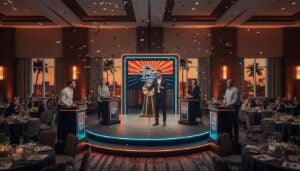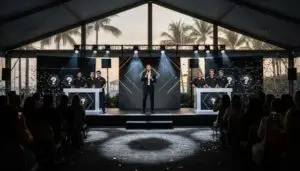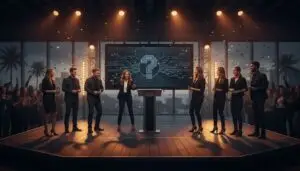

Ignite Your Team: High-Energy Game Shows for Unforgettable Corporate Events
Get ready for a game-changer! Our interactive team building game shows blend thrilling competition, seamless collaboration, and top-tier production to spark genuine connection and drive real results for your corporate events. This guide dives into how these electrifying experiences work, why they’re a secret weapon for boosting morale and communication, and how we tailor formats to smash your specific business goals. We’ll even cover how virtual and hybrid setups keep your dispersed teams in the game. For a trusted partner with proven local expertise and signature formats like “That’s What They Said,” “Big Music Game Show,” and “Quiz Show Challenge,” look no further than Game Show Trivolution, LLC. We’re Florida’s go-to for full-production game shows that deliver. Many companies struggle to make one-off events stick. This guide equips you with actionable strategies, platform insights, industry-specific playbooks, and ROI templates you can use right now. Expect powerful tactics, comparison tables to guide your choices, and step-by-step checklists designed for corporate planners aiming for high-impact, measurable team building.
What Are the Big Wins with Interactive Team Building Game Shows?
Interactive team building game shows are expertly crafted events that use game mechanics, shared challenges, and dynamic live production to supercharge morale, accelerate communication, and unlock your teams’ problem-solving superpowers. They work by creating short, high-energy rounds that demand quick thinking, teamwork, and immediate feedback, leading to laser focus and unforgettable shared moments. Your organization wins with sky-high participation, electrifying meeting vibes, and the chance to transform playful energy into lasting workplace collaboration. Here’s what you can expect:
Experience the proven benefits:
- Boosted Morale: Shared laughs and public wins forge stronger bonds and a more positive team spirit.
- Sharper Communication: Fast-paced rounds demand clear, concise exchanges and active listening.
- Elevated Problem-Solving: Engaging puzzles and collaborative trivia ignite creative and analytical thinking.
- Measurable Impact: Track participation and gather feedback to see direct engagement gains.
These benefits make game shows perfect for energizing conferences or giving teams a quick, powerful morale boost. Ready to see how shared success builds connection? Let’s dive in.
How Do Game Shows Amp Up Team Spirit and Connection?
Game shows supercharge team morale by creating shared victories, instant positive reinforcement, and public recognition that celebrates team efforts and deepens relationships. It’s simple: teams win together in quick, exciting rounds where laughter and friendly competition dissolve barriers and build invaluable social capital. Imagine an icebreaker round where everyone gets a moment in the spotlight, ensuring even quieter team members shine. This fosters inclusive connections across all departments. Design rounds that offer low-risk participation and clear wins, and watch that emotional uplift spill over into everyday teamwork. This naturally leads us to how game shows sharpen communication.
How Do Game Shows Make Communication and Collaboration Click?
The game mechanics in our shows are designed to demand clear roles, lightning-fast information sharing, and effective turn-taking, accelerating collaborative skills that translate directly back to the workplace. By assigning roles like “Researcher,” “Spokesperson,” or “Timekeeper” within each round, participants practice delegation and concise reporting under just the right amount of pressure, boosting clarity and reducing meeting friction. Facilitated debriefs that connect game decisions to real workplace scenarios help transform playful moments into actionable communication strategies. Consistent use of these mechanics significantly increases the likelihood that teams will adopt and maintain efficient communication patterns long after the event.
How Do Interactive Game Shows Spark Problem-Solving and Sharp Thinking?
Timed challenges, intricate puzzles, and mixed-skill rounds push teams to think analytically and creatively, forcing them to converge on solutions rapidly while harnessing diverse viewpoints. The core principle is focused problem-solving: limited time and clear rules encourage smart thinking, hypothesis testing, and quick improvements within a tight feedback loop. Consider a “mystery clue chain” round where teams must connect seemingly unrelated facts under a strict deadline—it’s just like tackling complex cross-departmental challenges in product development or operations. Post-game reflection prompts help teams identify the thinking strategies they used, strengthening their ability to apply those same powerful approaches in their daily work.
Which Game Show Formats Are Perfect for Your Corporate Team Building?

Picking the perfect format hinges on your event’s goals, the size of your audience, and the vibe you’re going for—from lighthearted icebreakers to deep-dive learning experiences. Our formats are designed to scale, offering adjustable energy levels and customization potential. By matching format features to your specific use cases, you can select shows that perfectly align with objectives like boosting morale, sharing knowledge, or energizing a conference. The table below offers a quick comparison of our signature formats to help you make an informed choice based on key features and benefits.
| Game Show Format | Key Features | Ideal Use Case / Benefit |
|---|---|---|
| That’s What They Said | Survey-style questions, audience polls, fun reveal moments | Perfect for breaking the ice and building company culture; encourages open sharing and understanding between teams. |
| Big Music Game Show | Music trivia, audio clips, high-energy pace | Ideal for boosting morale and social events; creates nostalgic connections and gets everyone involved. |
| Quiz Show Challenge | Knowledge-based rounds, competitive leaderboards, precise scoring | Excellent for reinforcing learning and energizing conferences; great for training sessions and knowledge checks. |
This comparison helps you align the tone and desired outcomes with your event goals. Now, let’s explore the unique features and customization options for each format in more detail.
What Makes Signature Shows Like “That’s What They Said” and “Big Music Game Show” Stand Out?
“That’s What They Said” uses clever survey insights and audience polling to uncover shared perspectives and foster empathy across teams, with rounds that reward smart guessing and group storytelling. “Big Music Game Show” is all about recognizing tunes and quick-fire answers, tapping into universal cultural touchstones to break the ice and ignite group energy. “Quiz Show Challenge” hones in on accuracy, speed, and leaderboard competition to solidify knowledge and spark healthy rivalry. Every format is ripe for customization—think branded question sets, company-specific themes, or integrated awards. Once you pick your format, a quick chat helps us align every round with your measurable objectives.
How Can Game Shows Be Crafted to Fit Your Company’s Vibe and Goals?
Tailoring your game show starts with a brief pre-event chat to capture your goals, desired tone, content boundaries, and branding needs. This information guides everything from the questions we ask to the host’s script and visual elements. We can swap generic trivia for company-specific facts, adjust the difficulty to match your team’s confidence, and weave in recognition moments that truly reflect your company values. We always recommend a content review period to ensure everything is a perfect fit—both culturally and compliantly. This process transforms general entertainment into powerful team development. Our customization checklist will help you gather all the essential inputs before we go into production.
What Branding Opportunities Are Built into Corporate Game Show Entertainment?
Our game shows are packed with high-impact branding opportunities. Imagine custom presentation slides, themed question rounds celebrating company milestones, shout-outs from the host, and prize packages that perfectly reflect your company culture. Visual branding on screens and materials reinforces your corporate identity, while in-show recognition amplifies your message. You can even extend the buzz with pre-event promotions and post-show digital assets, creating a seamless connection between the event and your ongoing internal communications. Smart branding turns entertainment into an integrated cultural experience that boosts your employer brand and internal marketing efforts.
How Do Virtual and Hybrid Game Shows Keep Remote Teams Connected?

Virtual and hybrid game shows bring geographically scattered teams together for synchronized, high-energy fun that rivals in-person events, thanks to smart production and the right technology. The key is parity-first design: ensuring remote participants have the same interaction tools (buzzers, polls, breakout rooms) and crystal-clear audio/visual feeds so they can compete and connect without missing a beat. Our best practices and technology choices ensure your remote teams feel fully immersed. The table below shows how different platforms and tools support remote engagement.
| Platform/Tool | Feature | How it supports engagement |
|---|---|---|
| Video conferencing with breakout rooms | Breakout sessions, gallery view | Facilitates small-group collaboration and maintains social dynamics during rounds. |
| Live polling and buzzer integration | Real-time response capture | Ensures fairness between in-person and remote players with instant scoring. |
| Streaming encoder / multichannel audio | High-quality AV, low-latency feeds | Synchronizes audio and video, immersing remote participants in the live energy. |
This table highlights key considerations for virtual setups. Now, let’s explore specific practices and integration tips to minimize lag and guarantee a fair playing field.
What Are the Top Tips for Engaging Remote Teams in Virtual Game Shows?
Engaging remote teams means keeping rounds short and punchy, having a high-energy host who actively encourages camera participation, and using frequent calls to action for chat or buzzer responses to maintain focus. Aim for rounds that last 60–90 seconds to match online attention spans. Rotate who’s on camera to prevent passive viewing and offer small incentives to boost participation. Technical rehearsals with remote participants and device checks are crucial for minimizing dropouts and lag. Always have backup rounds ready that don’t depend on perfect synchronization. These tactics ensure remote attendees feel seen and valued, and the technology choices we discuss next help make it all happen.
Which Technologies and Platforms Power Great Virtual and Hybrid Game Shows?
When choosing a platform, prioritize low-latency audio/video, seamless buzzer or polling integration, and the ability to deliver synchronized visuals to both remote and in-person audiences simultaneously. Essential features include live polling APIs, separate audio channels for the host and audience, and robust streaming encoders capable of multi-feed outputs to prevent lip-sync issues. Integration tips: test buzzer hardware compatibility with your chosen platform, conduct bandwidth checks, and assign a dedicated technical operator to monitor streams and latency. The table above covers three core tool categories and their role in ensuring parity; the best combination depends on your event’s scale and technical comfort level.
How Do Hybrid Events Seamlessly Blend In-Person and Virtual Engagement?
Successful hybrid events demand clear production roles—think technical director, AV tech, remote host liaison, stage manager—and synchronized cues to ensure both in-person and virtual participants get equal opportunities to engage. Operational checklists include dual-camera setups for stage coverage, separate audio mixes for broadcast and room sound, and shared scoreboard displays accessible to everyone. Mechanics that ensure equal participation, like letting remote teams control buzzer inputs and using joint leaderboards, minimize any perceived advantage for in-person attendees. Rehearsing transitions between in-room and virtual rounds during a full run-through guarantees precise timing and helps the host maintain energy across all channels. We’ll touch on this again in our booking preparation tips.
What Industry-Specific Game Show Ideas Drive Engagement in Healthcare, Finance, and Tech?
Industry-specific playbooks are key to tailoring content, pacing, and compliance considerations for maximum relevance and minimal risk. The right adaptation balances sensitivity, accuracy, and fun for each sector. Healthcare events focus on short rounds and respectful content that fits busy schedules and regulatory awareness, while finance events emphasize precision and controlled competition with transparent scoring. Tech company formats lean into problem-solving and innovation challenges that mirror product sprints and rapid prototyping. Here are some tailored ideas for each sector and why they work.
How Do Healthcare Teams Thrive with Customized Game Show Activities?
Healthcare teams benefit from short, engaging rounds that respect demanding shift schedules and avoid sensitive clinical topics, all while reinforcing teamwork and communication under pressure. Design considerations include using anonymized scenarios, offering multiple session times for shift workers, and incorporating debrief prompts focused on communication handoffs and rapid decision-making. Example rounds could simulate triage prioritization exercises or adherence quizzes that reward collaborative protocols over individual performance. When thoughtfully designed, game shows can refresh morale, combat burnout through social connection, and reinforce safety-focused teamwork.
What Are Winning Finance Industry Game Show Engagement Strategies?
Finance teams respond exceptionally well to accuracy-focused rounds that combine timed numeric challenges, scenario analysis, and transparent scoring, celebrating precision above all else. Effective strategies include leaderboards that prioritize accuracy over reaction time, rounds simulating regulatory decision-making with clear scoring rubrics, and debriefs that link game outcomes to real-world process improvements. Sample rounds might involve rapid reconciliation puzzles or risk-assessment multiple-choice scenarios that reward methodical reasoning. These formats sharpen attention to detail while allowing teams to practice high-stakes decision-making in a safe, engaging environment.
Which Game Show Formats Best Fuel Tech Company Team Bonding?
Tech companies gain the most from problem-solving and innovation-focused formats that mirror their fast-paced product development cycles, such as hackathon-style puzzle rounds and rapid ideation challenges with built-in constraints. Recommended formats include collaborative build rounds where teams prototype a feature concept under pressure, or debugging races that reward systematic diagnosis and teamwork. These activities champion cross-functional collaboration, creative constraints, and rapid iteration—skills directly applicable to engineering and product workflows. Adding follow-up sprints or idea capture sessions can even transform playful solutions into actionable product insights.
How Can You Measure the Real Impact and ROI of Your Corporate Entertainment?
Measuring ROI means pinpointing the right KPIs, matching them with concrete measurement methods, and scheduling short- and long-term follow-ups to capture both immediate sentiment and lasting behavioral shifts. Game shows typically influence participation rates, event NPS, short-term productivity indicators, and longer-term retention or culture metrics. Aligning each KPI with a measurement approach provides solid evidence for future investments. The table below maps KPIs to measurement methods and example impact metrics to guide you toward quantifiable outcomes.
| KPI | Measurement Method | Typical Impact / Example Metric |
|---|---|---|
| Participation Rate | Registration vs. Active Participants | 20–40% higher engagement than passive sessions |
| Event NPS / Satisfaction | Immediate Post-Event Survey | Average NPS uplift and positive qualitative feedback |
| Knowledge Retention | Pre/Post Knowledge Assessments | Percentage improvement in correct answers post-event |
| Behavioral Change | 30-/90-Day Follow-up Surveys & Performance Metrics | Observable increases in cross-team collaboration scores |
This mapping provides a practical toolkit for quantifying results and justifying repeat programming. The following sections offer detailed KPI definitions, survey examples, and a tracking timeline.
What KPIs Matter Most for Employee Engagement Events?
Top KPIs include participation rate, event Net Promoter Score (NPS), knowledge retention percentages, and downstream behavioral indicators like cross-team collaboration frequency and meeting efficiency. Here are the definitions and quick calculation methods: participation rate = active participants ÷ registrants; event NPS = % promoters − % detractors on an immediate survey; knowledge retention = post-test correct % − pre-test correct %. These KPIs offer both immediate sentiment and proof of skill transfer. Combining them in a dashboard allows you to present a concise performance story to stakeholders.
How Do Feedback Mechanisms and Surveys Illuminate Event Effectiveness?
Feedback mechanisms should include an immediate post-event survey to capture sentiment and follow-ups at 30 and 90 days to measure behavioral change and retention. Include both closed Likert-scale items and a couple of open-ended prompts for qualitative insights. Here are five sample survey questions:
- Overall satisfaction (Scale of 1–10)
- Likelihood to recommend (NPS)
- Perceived teamwork improvement (Agree/Disagree)
- Most valuable moment (Open-ended)
- Suggestions for improvement (Open-ended)
Timing these surveys—immediate, 30 days, and 90 days—helps distinguish between event enjoyment and longer-term impact on collaboration and productivity. Compiling these responses into trend reports reveals whether individual events lead to lasting changes.
What Is the Long-Term Impact of Game Shows on Productivity and Retention?
Long-term impact is best tracked through a 3–6 month evaluation plan that connects event participants to downstream metrics like cross-functional project initiation rates, internal mobility requests, and retention comparisons against baseline cohorts. Recent program evaluations indicate that experiential learning events can yield measurable boosts in team cohesion and short-term productivity. Planners should design longitudinal studies with control groups or baseline measures whenever possible. By aligning post-event behavioral KPIs with human resources data, organizations can estimate the return on engagement investment and refine program cadence for sustained culture building.
Why Partner with Game Show Trivolution, LLC for Your Florida Team Building Game Shows?
Game Show Trivolution, LLC delivers Florida-based, full-production game show entertainment that combines professional hosting, cutting-edge wireless buzzer systems, dynamic visuals, and customizable formats specifically designed for corporate audiences. Our local experience and robust production capabilities provide a practical advantage for Florida event planners seeking seamless, reliable solutions. Here are the core unique value propositions and production attributes that matter most to corporate buyers:
- Experience & Scale: Extensive production history ensures polished, repeatable delivery for corporate clients.
- Signature Formats: Customizable shows like “That’s What They Said,” “Big Music Game Show,” and “Quiz Show Challenge” are tailored to your specific event goals.
- Full Production Power: Professional hosts, wireless buzzers, dynamic lighting, music, and A/V equipment create a true TV-style experience.
- Peace of Mind: We carry $2M in liability insurance and offer Florida-wide service, providing essential assurance for procurement.
These factors position us as the ideal partner for planners who demand both creative flair and technical dependability. Let’s explore our unique selling points, production advantages, and how clients typically engage with us.
What Unique Value Does Game Show Trivolution Bring to the Table?
Game Show Trivolution offers a powerful blend of format variety, production depth, and comprehensive Florida coverage, enabling rapid event execution and dependable on-site logistics. Our signature formats provide ready-to-go options that directly address common corporate objectives—icebreakers, morale boosts, or knowledge reinforcement. Plus, our customization services ensure content aligns perfectly with your company culture and compliance needs. The emphasis on professional hosts and full AV production significantly elevates the perceived value and participant engagement. These unique selling points make it easy for event planners to select a format and trust the entire production process, which we detail further in our production specifics.
How Does Full Production Elevate the Game Show Experience?
Full production elements—wireless buzzer systems, synchronized dynamic lighting, impactful musical cues, and expert host direction—craft a broadcast-quality experience that amplifies excitement and participation. The magic lies in sensory immersion: polished audiovisuals and instant scoring provide clear feedback, raising the perceived stakes and creating stronger emotional memories and social bonds. For hybrid or virtual events, our production standards include technical rehearsals and AV monitoring to maintain parity across all audiences. Investing in full production transforms a standard icebreaker into a headline event that participants will remember and talk about long after it’s over.
What Can Clients Expect from Their Game Show Trivolution Experience?
Game Show Trivolution’s proven track record of producing thousands of live shows offers planners an operational baseline and confidence in consistent, high-quality delivery for diverse event types across Florida. While specific client testimonials are verified externally, you can expect documented examples and case highlights showcasing measurable engagement outcomes and logistical expertise. If you require references or detailed case studies, we recommend asking the provider for anonymized summaries and KPIs from recent events. This approach helps procurement teams validate suitability without relying on generic claims.
How Do You Book and Prepare for Your Interactive Team Building Game Show?
Booking and preparation follow a clear, streamlined process designed to ensure perfect alignment between your event goals and our production execution: needs assessment, proposal and agreement, pre-event customization, technical rehearsal, and day-of execution with post-show feedback. Well-defined checkpoints throughout the planning reduce last-minute changes and guarantee that content, AV, and logistics are perfectly aligned with your objectives. The checklist below outlines a practical booking flow with estimated timelines to guide corporate planners.
- Initial Inquiry & Needs Assessment: We capture your goals, audience size, format preferences, and desired date.
- Proposal & Agreement: Review our recommended format, production specs, pricing, and insurance details.
- Content Customization & Approval: Provide your company facts, branding assets, and any content constraints for question sets.
- Technical Rehearsal & Run-Through: Schedule a full AV and platform test, including buzzer and streaming checks.
- Day-of Execution & Post-Event Survey: We deliver the show with a dedicated technical team and capture immediate feedback.
This checklist simplifies procurement and establishes predictable milestones for planners. The following sections provide more detail on customization inputs, day-of expectations, and logistical tips.
What Is the Booking Process for Corporate Game Shows in Florida?
Booking typically kicks off with a needs assessment to confirm your objectives, date availability, and desired format. This is followed by a proposal detailing production requirements, deliverables, and the next steps for customization. Once the proposal is accepted, you’ll provide branding assets and content preferences during a formal intake session, which includes compliance checks for sensitive industries. A technical rehearsal is scheduled before the event to verify buzzer integration, streaming quality, and staging details. Clear deadlines for content approval and AV logistics ensure a smooth lead-up to the event and minimize last-minute scope changes.
How Can Event Planners Make Their Game Show Experience Uniquely Their Own?
Planners customize shows by providing key inputs on goals, preferred tone, content constraints, and branding elements through a structured intake form covering question themes, prize preferences, and AV specifications. Common choices include opting for competitive versus collaborative scoring, incorporating company-specific trivia, and integrating award moments or sponsor shout-outs. Submitting logos, slide templates, and sample questions early speeds up production and ensures visual consistency throughout the show. These inputs empower us to craft a truly tailored experience that aligns perfectly with both your culture and measurable outcomes.
What Should Teams Expect on the Big Day of the Game Show?
On the day of the show, expect about 90 minutes for technical setup, followed by a brief warm-up and host briefing, the live show segment, and a 10–30 minute post-show wrap-up including survey distribution and debrief. Our production teams typically arrive early to set up wireless buzzer systems, test audio/video feeds, and conduct a quick host rehearsal with local AV staff to confirm sightlines and screen content. The host will orient everyone and explain the scoring before the first round, ensuring all participants understand the rules and how to engage. After the show, we collect immediate feedback while the excitement is still fresh, completing the recommended engagement cycle.
Team Building Through Video Games: Enhancing Productivity and Cohesion
ABSTRACT: Important organizational work is often performed in teams. Therefore, effective teamwork has long been a critical area for research [1,2]. Yet, evidence continues to emerge that shows teamwork is often ineffective. For example, one practitioner survey found that 97% of employees and executives believe that team alignment is critical to their effectiveness, yet 86% blame a lack of effective team collaboration for workplace failures [3]. As a result, although a strong body of research exists on effective teamwork, there is continual need for research on how to build productive teams.
1. Information Systems Department, Marriott School of Business, Brigham Young University, Provo, UT, United States
2. Background:Organizations of all types require the use of teams. Poor team member engagement costs billions of US dollars annually.
3. Objective:This study aimed to explain how team building can be accomplished with team video gaming based on a team cohesion model enhanced by team flow theory.
4. Methods:In this controlled experiment, teams were randomly assigned to a team video gaming treatment or a control treatment. Team productivity was measured during both pretreatment and posttreatment team tasks. After the pretest, teams who were involved in the team video gaming treatment competed against other teams by playing the Halo or Rock Band video game for 45 minutes. After the pretest, teams in the control treatment worked alone for 45 minutes. Then, all teams completed the posttest team activity. This same experimental protocol was conducted on 2 different team tasks.
5. Results:For both tasks, teams in the team video gaming treatment increased their productivity significantly more (F1=8.760,P=.004) on the posttest task than teams in the control treatment. Our flow-based theoretical model explained team performance improvement more than twice as well (R2=40.6%) than prior related research (R2=18.5%).
Team building through team video games: Randomized controlled trial, MJ Keith, 2020
Got Questions? We’ve Got Answers!
What kinds of companies get the most out of interactive team building game shows?
Pretty much any industry can benefit! Healthcare, finance, and tech are just a few examples where we tailor the game show experience to fit specific needs—think boosting communication in healthcare, sharpening accuracy in finance, or sparking innovation in tech. By customizing the content and pace, we ensure the game shows truly resonate with your teams, leading to better morale and collaboration.
How can we make sure virtual game shows are inclusive for everyone?
It all comes down to “parity-first” design. This means giving remote participants the same chances to interact with tools like buzzers and polls, and ensuring top-notch audio and visual quality. We also create rounds where everyone can jump in actively, no matter where they’re joining from. This fosters a real sense of belonging and engagement for all, building a more cohesive team environment.
What are the usual hurdles when organizing hybrid game shows?
Key challenges often include ensuring both in-person and remote participants feel equally engaged, navigating potential technical glitches, and keeping the energy high across different formats. Planners need to meticulously coordinate logistics, like AV setups and interaction mechanics, to avoid any disparities in the experience. Plus, running through transitions between in-person and virtual segments is crucial for a smooth, engaging event from start to finish.
How can we best use feedback from game shows for future events?
Leverage feedback by conducting immediate post-event surveys and follow-up assessments at 30 and 90 days. This captures both instant reactions and longer-term behavioral shifts. Analyzing this data helps pinpoint what worked well and where improvements can be made, allowing you to refine your event strategies, enhance participant experiences, and better align future game shows with your corporate objectives.
What’s the secret sauce a professional host brings to a game show?
A professional host is the engine that drives a game show’s success! They energize the crowd, guide participants seamlessly through the event, and ensure smooth transitions between rounds. Their knack for engaging the audience, managing time like a pro, and maintaining a vibrant atmosphere elevates the entire experience. A skilled host can even adapt to the audience’s energy, making the event feel more personal and enjoyable, which directly boosts engagement levels.
What are some smart ways to measure if a game show event was a hit?
Measuring success means tracking key performance indicators (KPIs) like participation rates, Net Promoter Score (NPS), knowledge retention, and post-event behavioral changes. Using immediate feedback surveys and follow-up assessments gathers both quantitative and qualitative data. By analyzing these metrics, you can gauge the event’s impact on employee engagement and collaboration, providing invaluable insights for future programming.
How can game shows become part of your ongoing team development efforts?
Integrate game shows into your ongoing team development by aligning their objectives with broader company goals, such as improving communication or fostering innovation. Weaving game show elements into regular training or team-building activities can reinforce skills learned during the event. Furthermore, using the insights gained from game shows to inform future workshops or collaborative projects ensures that the benefits extend far beyond the event itself.
Ready to Elevate Your Next Event?
Bringing interactive team building game shows to your corporate events is a powerful way to boost employee engagement, supercharge morale, and enhance communication. These dynamic formats don’t just foster collaboration; they deliver measurable results that align perfectly with your organizational goals. By selecting the ideal game show format, you can create unforgettable experiences that spark lasting behavioral changes. See how Game Show Trivolution can transform your next corporate event—explore our exciting range of offerings today!